Often the real cause
Attic Ventilation Installation in Cypress, TX
Correcting attic intake and exhaust airflow — the problem underneath a surprising number of roof failures.
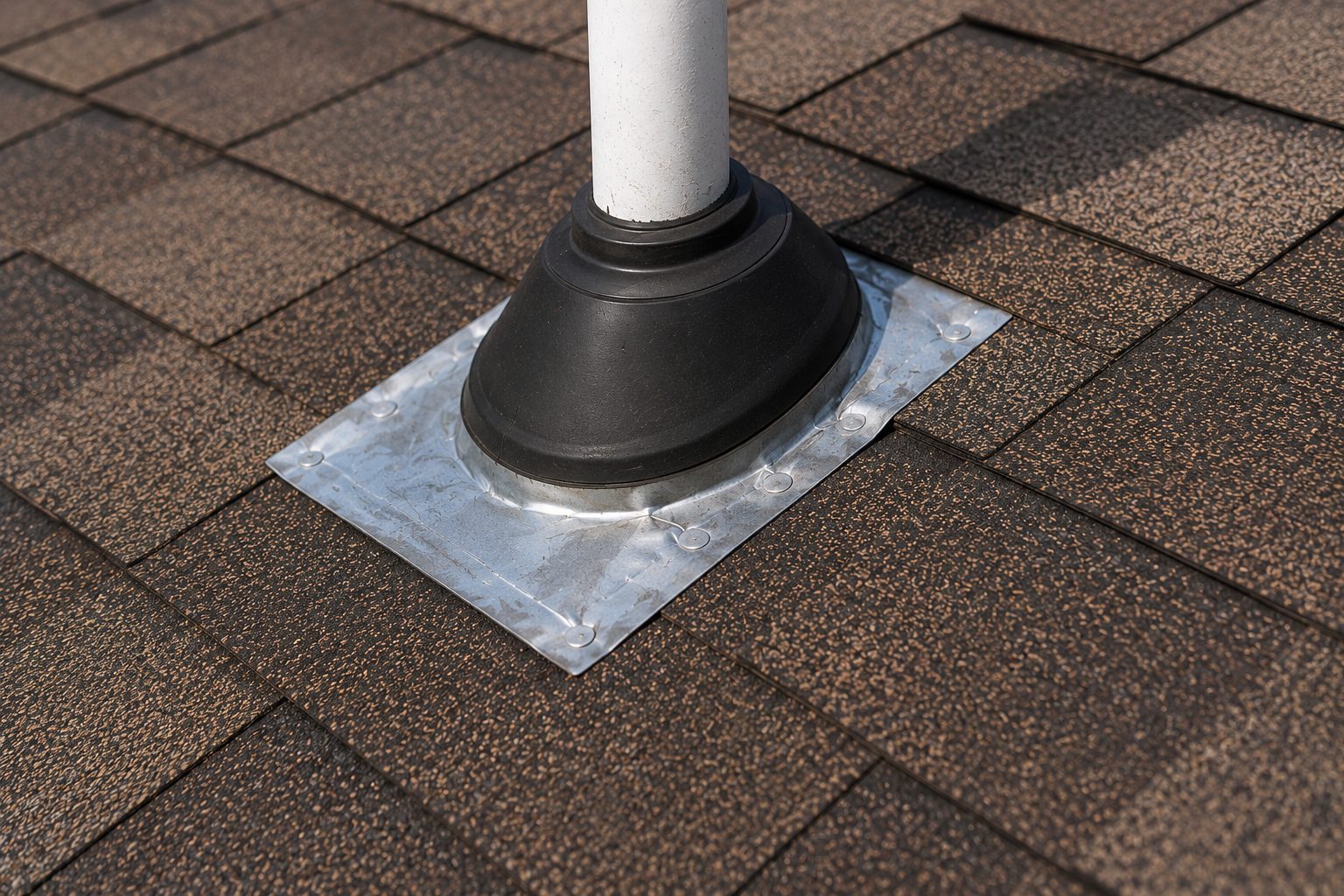
What this actually is.
A Houston attic in August is one of the hottest places anyone owns. When that heat has nowhere to go, it cooks the roof from underneath: shingles age faster than their rating, adhesive softens, and moisture that should be venting out condenses on the decking instead. Homeowners usually discover this after their second premature roof.
We check whether the intake at the eaves is genuinely open rather than merely present, whether the exhaust is enough for the space, and whether two different exhaust types are quietly fighting each other on the same plane. Then we quote what it takes to balance it.
- An attic that is brutally hot even by Houston standards
- Upstairs rooms that will not hold temperature
- Condensation, frost, or dark staining on the underside of decking
- Shingles that failed well before their rated life
- Musty smell or visible mold growth in the attic
- Soffit vents blocked by blown-in insulation
How a roof is supposed to breathe
The principle is simple and it runs on nothing but physics. Hot air rises. If you give it a way out at the top of the attic and a way in at the bottom, it leaves through the top and pulls cooler outside air in behind it through the eaves. The attic empties itself continuously, for free, with no moving parts.
The way in is the soffit — the underside of the roof overhang, where vents let air enter low down. The way out is at or near the ridge. Both halves have to be there. Exhaust with no intake has nothing to draw, and intake with no exhaust has nowhere to go.
This is why ventilation is a roofing job rather than an HVAC one. It is built into the roof, most of it is only reachable from the roof, and it is the reason a great many roofs fail early.
The mistake that makes ventilation worse
The instinct when an attic is too hot is to add another vent. It is usually the wrong move, and it can make things actively worse.
The reason is that exhaust vents pull air from wherever it is easiest to get it. Put two different types of exhaust on the same roof plane — say a ridge vent and a powered fan, or a ridge vent and box vents — and the stronger one will often draw its air from the other vent instead of from the soffits. Outside air comes in through one hole in the roof and straight back out through another a few feet away. The attic itself barely moves. In wind-driven rain, an exhaust vent being used as an intake is also a way for water to get in.
So the honest answer to a hot attic is rarely more vents. It is usually a balanced system: one type of exhaust, and enough open intake at the eaves to feed it.
The intake nobody checks
In practice the failure is almost always at the intake end, and almost always for the same reason. At some point the attic was insulated, the insulation was blown in toward the edges, and it buried the soffit vents. From inside the attic it looks fine. From underneath, the vents are still visible. But there is no path for air between them.
Baffles are the fix — rigid channels stapled between the rafters at the eave that hold the insulation back and keep an open run from the soffit into the attic. They are cheap and they are frequently missing.
The other common version is soffit vents that have been painted over, or a soffit that was replaced at some point with a solid panel and never re-vented. If you are having soffit and fascia work done, that is exactly the moment to make sure the intake goes back in, because everything is already open and accessible.
What moves the price.
We do not price a roof we have not been on. These are the things that actually move the number once we have.
What has to be cut
Adding ridge exhaust means cutting a slot along the ridge and reworking the cap. Adding intake may mean cutting new soffit vents. Both are more involved than dropping a vent into an existing hole.
Whether insulation has to be moved
If blown-in insulation has buried the eaves, someone has to get to the edge of the attic, pull it back and fit baffles between every rafter bay. It is awkward, hot work and it is often the bulk of the labor.
Roof size and how many planes
A balanced system has to work on each roof plane, so a house with several separate roof sections needs the calculation done more than once.
Whether it is done with a re-roof
Ventilation work is substantially cheaper as part of a replacement, because the roof is already open. Doing it on its own means opening the roof specifically for it.
What to ask before you hire anyone.
Texas does not license roofing contractors, so the checks nobody did for you are the checks you make yourself. Four that are worth the awkwardness.
- Is my intake actually open, or just present?
This is the question that finds the real problem in most houses. Visible soffit vents mean nothing if there is insulation packed against the back of them, and it takes someone in the attic to know. - Are we mixing exhaust types on the same roof plane?
If the proposal adds a ridge vent to a roof that already has box vents or a powered fan, ask what happens to the old ones. Leaving both in place is the classic mistake. - Does my shingle warranty specify a ventilation ratio?
Some manufacturer warranties do, and an under-ventilated attic can void the cover on the roof above it. If your roof is still within its warranty period this is worth checking before you spend anything. - Do I need baffles, and are they in this price?
Baffles are the difference between an intake that works and one that is decorative. They are also easy to leave out of a quote quietly, because nobody can see whether they are there.
What happens after you call.
Tell us what the roof is doing
Call or send the form. A leak in the hall ceiling, missing shingles after a storm, a stain that keeps growing — whatever you are actually seeing. You do not need to know the cause.
We come and find the source
We look at the roof plane, the attic side, and the components most likely to be responsible. The wet spot is rarely under the hole, so we trace it rather than guess at it.
You get a plain explanation and a price
What failed, what it will take to fix, and what can reasonably wait. In writing, in language that does not need decoding.
We do the work
Scoped to what we actually found. If a targeted repair solves it, that is what we quote — we are not looking for a reason to sell you a roof.
Attic Ventilation Installation — what people ask.
Do more vents always help?
No, and this is the most common error. Mixing exhaust types on one roof plane can make the roof pull air from another vent instead of from the soffits, which short-circuits the whole system.
Is this really a roofing job?
Yes. Ventilation is part of the roof system, and inadequate airflow voids some manufacturer warranties on the shingles above it.
Will it lower my cooling bill?
It can help, though how much depends on your insulation, ducting and house. The stronger argument is roof life — a ventilated roof reaches the age it was sold to you as.
What about a powered attic fan?
They have their advocates and they do move air. The concerns are that a powered fan without enough intake can pull conditioned air out of the house through gaps in the ceiling, which makes your air conditioning work harder, and that combining one with a ridge vent short-circuits both. If someone proposes a fan, ask them how the intake is being sized to feed it.
Is a hot attic actually a problem, or just uncomfortable?
It is a problem for the roof. Heat accelerates the aging of the covering above it and softens the adhesive that seals the shingles down. It is also a moisture problem in this climate, because humid air with nowhere to go condenses on the underside of the decking, and decking that stays damp does not stay sound.
How do I know if it is bad enough to fix?
The clearest signs are dark staining or condensation on the underside of the decking, insulation packed hard against the eaves, and a roof that failed noticeably early. If you are replacing a roof that did not last as long as it should have, get the attic looked at as part of that job — otherwise the new one gets the same treatment.
Can I check the soffit vents myself?
Partly. From the ground you can see whether soffit vents exist and whether they have been painted shut. What you cannot see from there is whether insulation is blocking them on the inside, and that is where the problem usually is. If you can get into the attic safely, look along the very edge where the roof meets the exterior wall.
How many years do roofs last in Texas?
Less than the shingle warranty implies. Published figures for the Houston area put asphalt shingle roofs at roughly 15 to 25 years, with builder-grade three-tab at the lower end. Ventilation is a bigger factor in that spread than most people expect: shingle surfaces in direct Texas sun get hot enough to soften and oxidise the asphalt binder, and an under-ventilated attic cooks the same shingle from underneath, where no inspection from the driveway will ever find it. Fixing airflow is one of the few things that changes the number rather than just resetting it.
Other roofing work we do.
Need attic ventilation installation in Cypress?
Free written estimate, no obligation. Call or send the form.
Free · No obligation · We are a roofing service, not a contractor