Most common request
Roof Repair in Cypress, TX
Targeted repair for leaks, storm damage, failed flashing and missing shingles — without replacing a roof that does not need replacing.
What this actually is.
Most roofs that leak do not need to be replaced. They need one thing found and fixed. The problem is that the wet spot on your ceiling is almost never underneath the actual failure — water travels along decking and rafters before it drops. That is why a roofer who patches where the stain is often gets called back a month later.
We inspect the roof plane, the attic side, and the components where leaks actually start — flashing, valleys, penetrations, roof-to-wall transitions and the drip edge. They trace the water back to its entry point rather than sealing the visible symptom, then quote the repair.
- A ceiling stain that grows after every rain
- Shingles missing, curled, or lifted at the edges
- Granules collecting in gutters or at downspout splash blocks
- Daylight visible through decking from inside the attic
- Damp or matted insulation in one section of the attic
- Rusted, lifted, or separated flashing around a chimney or vent
Water does not fall straight down
A leak enters the roof at one point and lands inside at another, sometimes a long way off. Water gets through the roof covering, hits the decking, and then runs. It follows the slope of the plywood, tracks sideways along a rafter, soaks along the top edge of the insulation, and finally drips wherever it runs out of somewhere else to go. That drip is what stains your ceiling.
This is the single reason repairs fail. A roofer who goes up, finds the nearest damaged shingle above the stain, seals it and leaves has fixed something. It just may not be the thing that was letting water in. When the next real rain comes, the stain grows again, and the homeowner concludes the roof needs replacing when it never did.
A proper repair works backwards from the drip: inside the attic first, following the water stain uphill along the framing to where it starts, and only then onto the roof to look at what is directly above that point.
The places a roof usually gives up first
Roofs rarely fail in the middle of a clean run of shingles. They fail where something interrupts the field — where two planes meet, where a pipe comes through, where the roof runs into a wall. Those interruptions are handled by flashing and sealant, and both have a shorter life than the shingles around them.
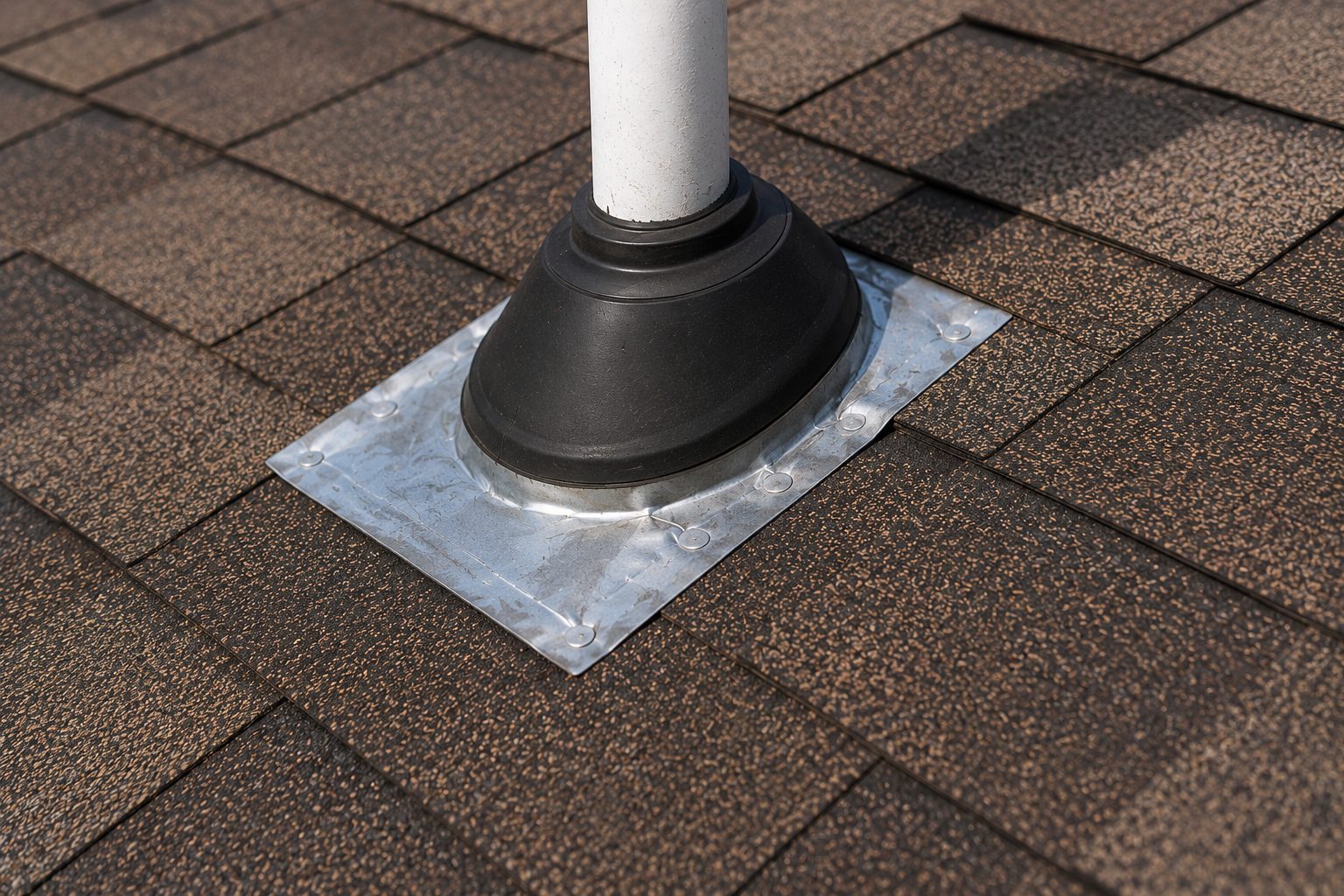
The usual suspects, in roughly the order a contractor checks them: the rubber boots around plumbing vents, which go brittle and split from years of sun; step flashing where the roof meets a wall or chimney; valleys, where two planes dump their combined water into one channel; the drip edge at the eaves; and nail heads that have backed out and lifted the shingle above them.
None of these are expensive to fix on their own. All of them are expensive to ignore, because what they damage is not the roof — it is the decking, insulation, drywall and framing underneath it.
What Gulf Coast weather does to a repair
Two things here are harder on a roof than in most of the country. The first is sustained heat. Sealant that would last years in a milder climate goes hard and cracks faster on a Houston roof, and a repair that depends entirely on a bead of caulk is a repair with a short clock on it. The second is that rain here tends to arrive all at once. A valley or gutter that copes with steady drizzle can be overwhelmed by a downpour and push water backwards under the shingle edge.
It is worth asking a contractor whether the repair they are proposing is mechanical or chemical — whether it works because a piece of metal now directs water somewhere, or because something is glued. Both have their place. Sealant alone, on a leak that needs flashing, is a repair you will be paying for twice.
Heat is also why a roof here can be nearer the end of its life than its age suggests, particularly if the attic underneath it has never vented properly. If a contractor keeps finding new failures each visit, ask them to look at attic ventilation before you spend more on repairs.
What moves the price.
We do not price a roof we have not been on. These are the things that actually move the number once we have.
How far the damage runs
The visible damage is the starting point, not the scope. Rot and wet decking usually extend past what you can see from the ground, and nobody knows how far until the covering comes off.
Access and pitch
A steep roof needs harnesses and staging and takes longer to work safely. A low, walkable roof with a clear driveway beside it is a quicker job than the same repair three stories up over a flowerbed.
What is under the shingles
If the decking is sound the repair stays a roofing job. If water has been getting in long enough to soften the plywood, that decking has to come out and be replaced before anything goes back on top.
Material and matching
Common architectural shingles are easy to source. Tile, metal, and discontinued or unusual profiles are not, and matching an aged roof is a real constraint that affects both price and how the finished repair looks.
What to ask before you hire anyone.
Texas does not license roofing contractors, so the checks nobody did for you are the checks you make yourself. Four that are worth the awkwardness.
- Show me where the water is actually getting in.
A contractor who has found the entry point can point at it, usually with a photo. One who is working from the ceiling stain alone is guessing, and you will find out in about a month. - Is the decking under this still sound?
This is the difference between a repair that holds and one that fails from underneath. It also tells you whether the price you are being quoted is likely to move once work starts. - What does your warranty cover, and for how long?
Repairs carry a workmanship warranty from the contractor, separate from any manufacturer warranty on materials. Get the length and what voids it in writing before work starts, not after. - Can I see your current insurance certificate?
Texas does not license roofing contractors, so insurance is the main thing you can actually verify. You want current general liability and workers compensation. Any legitimate contractor produces both without hesitation.
What happens after you call.
Tell us what the roof is doing
Call or send the form. A leak in the hall ceiling, missing shingles after a storm, a stain that keeps growing — whatever you are actually seeing. You do not need to know the cause.
We come and find the source
We look at the roof plane, the attic side, and the components most likely to be responsible. The wet spot is rarely under the hole, so we trace it rather than guess at it.
You get a plain explanation and a price
What failed, what it will take to fix, and what can reasonably wait. In writing, in language that does not need decoding.
We do the work
Scoped to what we actually found. If a targeted repair solves it, that is what we quote — we are not looking for a reason to sell you a roof.
Roof Repair — what people ask.
Can a roof be repaired instead of replaced?
Frequently, yes. If the roofing system is sound overall and the failure is confined to a specific area, a targeted repair is usually the practical option. We will tell you which one it is, with photographs, before anything is quoted.
How fast can you look at it?
It depends on the weather — after a widespread storm, every roofer in Harris County is booked, us included. Active leaks go ahead of non-urgent requests.
What does a repair cost?
We do not quote a price over the phone. We price the roof after we have seen it, because the honest answer depends on access, pitch, material and how far the damage actually runs.
Will a repair void my roof warranty?
It can, depending on the warranty and who does the work. Manufacturer material warranties often have conditions about how repairs are carried out and by whom, and some are void if the roof is not ventilated to their specification. If your roof is young enough to still be covered, find the paperwork before anyone starts work.
Should I put this through insurance?
It depends on what caused it. Policies generally deal with sudden damage such as wind or hail, and generally do not cover wear or a failure that developed slowly. Photograph everything before any repair happens and talk to your carrier early. We are not qualified to advise on your policy and we do not handle claims.
Can I just have someone seal it for now?
Sometimes, as a deliberate temporary measure while you arrange the real repair. The problem is when sealant becomes the permanent answer to a flashing problem, because it hides the leak rather than stopping it, and the damage underneath carries on quietly.
The roofer says it needs a full replacement. Is that true?
It might be. It is also the more expensive answer, so it is reasonable to ask them to show you why — photographs of the failing areas, and an explanation of what makes this a system-wide problem rather than a local one. Getting a second opinion on a replacement quote is normal and no honest contractor is offended by it.
How much does it cost to repair a roof in Texas?
Repairs vary far more than replacements, because the price follows what actually failed. A split vent boot or a short run of flashing is a small job; a valley rebuilt with rotten decking under it is not. What moves the number is how far the damage runs, whether the decking is sound, the pitch and access, and how many layers are already up there. For scale at the other end, published figures put most Houston-area reroofs with architectural asphalt somewhere around $7,500 to $16,500 in 2026. We do not price roofs over the phone — anyone who does is quoting a roof they have never seen.
How much would it cost to repair my roof?
We cannot tell you honestly without looking, and it is worth knowing why rather than taking that as a dodge. The same visible symptom — a stain on a ceiling — can be a twenty-minute flashing fix or a section of decking that has been wet for two years. Until someone has been on the roof and in the attic, any number is a guess dressed up as a quote. The visit and the written estimate are free, so the honest answer costs you nothing.
How can I afford a roof repair?
Three routes worth knowing before you pay out of pocket. If the damage is storm-related, check your policy first — that is what it is for. Second, urgent and deferred work can usually be separated: stop the water now, schedule the rest, and get that split written into the estimate. Third, financing is widely available; if you use it, ask for the terms rather than the monthly figure. What we would steer you away from is the cheapest possible patch on a roof that needs more, because that is how people pay twice.
Other roofing work we do.
Need roof repair in Cypress?
Free written estimate, no obligation. Call or send the form.
Free · No obligation · We are a roofing service, not a contractor